What Did the Ancient Egyptians Wear That Is Common in Todays Fashion Trend
Angela loves history and feels it is essential to our future to know the past—or else be destined to echo it.
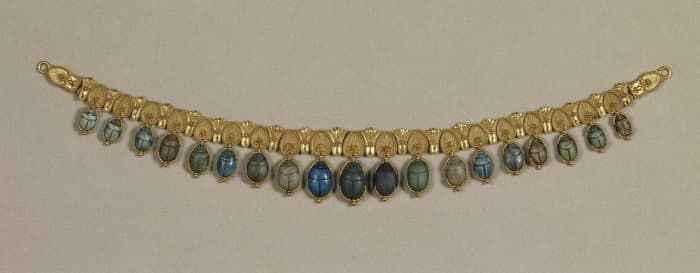
In Ancient Egypt, jewelry played a big part in their order. The richer Egyptians tended to vesture the jewelry with gold and gems, whereas the poorer Egyptians commonly fabricated theirs out of glass beads.
Walters Fine art Museum, via Wikimedia Commons
Fabrics Used In Egyptian Clothing
In Aboriginal Egypt, manner was a large part of their culture. Depending on what a person wore and how they wore information technology, told a story well-nigh the person themselves. Men, women, and children all wore unlike styles of clothing, even so all of them enjoyed adornments such equally jewelry and make-up.
Due to Egypt'southward hot, humid atmospheric condition, the aboriginal Egyptians preferred lightweight clothes, like linen, although silk was often bought by the wealthy. Those of the everyman status would use cotton or wool. Establish fibers such equally flax that grew forth the Nile River would be soaked, combed, and so beaten into thread-like fibers to brand linen. Once they became threadlike, they would then be spun and placed on a loom. Usually, men were the ones who harvested the flax stalks, while women were the ones who would spin the flax thread and make the garments.
Another standard fabric used among Pharaohs and priests was leather. Near leather was thought to exist impure; therefore, they did not make about articles of wear; instead, they made coats out of leather. One exception was that of leopard skin named padelide, which the priests and Pharaohs ofttimes wore. Pharaohs would also wear a lion'south tail around their waist like a belt.
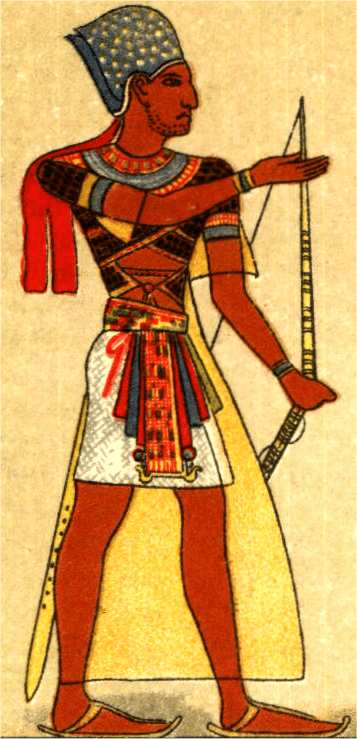
Men often wore wraparound skirts with a chugalug and lots of jewelry.
unknown, Wikimedia Commons
Egyptian Clothing for Men
Status was indicated in big part past how a homo dressed. The workers, who were the poorest in the community, nearly often wore loincloths made of cotton and sometimes linen or wool. The rest of the men would ordinarily clothing a wraparound skirt made with linen and tie a chugalug around their waist. This skirt was called Shendyt. They did as piddling sewing as possible in most of their garments. They also rarely dyed their items and normally wore white, which was in part due to their desire to be clean. White gave a cleaner advent.
Sometimes the skirts would also be wrapped around their legs likewise, giving a more pants feel. They did this more than oftentimes in the winter than in the summertime months. The length of the Shendyt worn past men varied throughout history. During Erstwhile Kingdom (Before 2055 BC), men wore them above the knee, and the material often gathered in the forepart or pleated. During the Middle Kingdom (2055 BC to 1650 BC), men wore their Shendyt longer; it would touch their calf. During the New Kingdom (1650 BC to 1069 BC), men also wore tunics that had sleeves, too as pleated petticoats.
Regardless of what era, the richer you were, the lighter the material used on your garments. Some garments worn by Pharaohs and priests, who ranked as the highest form, wore an almost see-through cloth. Silk and linen were most commonly used in this group, whereas those of poorer status might habiliment linen, cotton, or fifty-fifty wool.
In Tutankhamen's tomb, they found many more items of clothing than was expected, which implied that men might have worn a wider variety of clothing than initially thought. In that location were items such equally underwear, shirts, tunics, aprons, sashes, socks, scarves, and gloves; they wore during the colder months. In contrast, the skirts depicted on many of the Egyptian drawings were more accurate during the warmer periods.
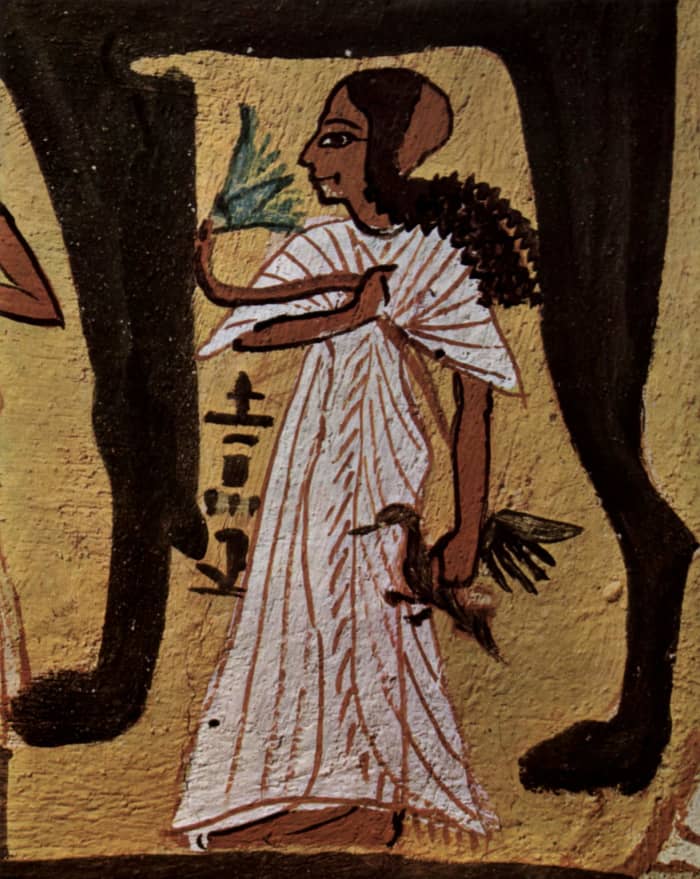
The dresses worn by Ancient Egyptian women were ofttimes pleated, and commonly covered either one shoulder or both.
The Yorck Projection, via Wikimedia Commons
Egyptian Clothing for Women
Women, like men, also used very lightweight fabrics for their clothing, plus status was merely as important. The higher the position, the thinner the cloth. Dissimilar the men, women unremarkably wore full-length dresses that would either have i or two shoulder straps, but minimal sewing, if any. These dresses, depending on the period, would sometimes prevarication below the breast, simply nearly often covered the chest.
Regardless of what era, the fabric was ever very elementary and usually white.
Dresses had a lot of way to them, such as pleating. In the Onetime Kingdom, they ofttimes wore horizontal pleating, whereas, in the New Kingdom, it was generally vertical. During the Middle Kingdom, pleating was much more all-encompassing. Sometimes it would be horizontal with vertical pleating overlapping. How they achieved this pleated look is unknown.
Occasionally women would accept feathers and beading across the chest area, simply mostly the cloth was bare. Over the dress, women would ordinarily wear a robe or cape, with pleats too.
Egyptian Clothing for Children
Egyptian children, until the age of six, did not habiliment apparel during the hottest months. At six years of age, they were allowed to wear clothing for protection from the sunday, just they did not begin to article of clothing regular apparel until they hit puberty, in which case they would begin to dress similar adults. Although the children were often naked, they still wore jewelry like their parents, especially bracelets, collars, and hair accessories. During the colder months, when temperatures could get as low as ten degrees, they would habiliment wraps and cloaks. Since it was common cold for such a curt time, this was non everyday garb.
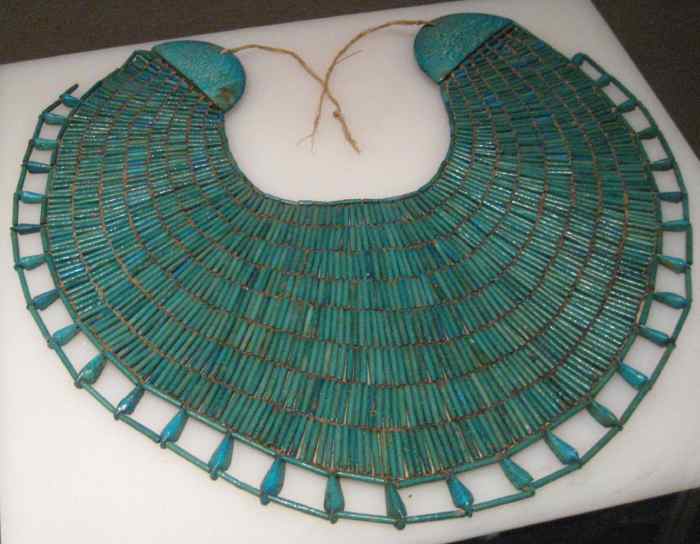
Some Egyptians would wear ornate collars like this one.
unforth on flickr, via Wikimedia Commons
Scroll to Continue
Read More From Owlcation
Egyptian Jewelry
Jewelry was a meaning role of Egyptian culture. The style of jewelry ane wore indicated one's status. Aboriginal Egyptians felt jewelry made them appear more appealing to the gods, so they would wear as much as they could. They oft wore bracelets, necklaces, rings, fanciful buttons, earrings, neck collars, and pendants. The jewels had an Asian influence with its bulky advent.
The higher course a person was, the more gold and precious gems they would use in the making of the jewelry. The most common gems were Turquoise - a greenish-blue gemstone, Lapiz-lazuli - a brilliantly bright blue gemstone, and Carnelian - a shine reddish-brown stone. The lower class would however decorate in lots of bulky jewelry, although they used pottery beads or glassware for decoration rather than gems.
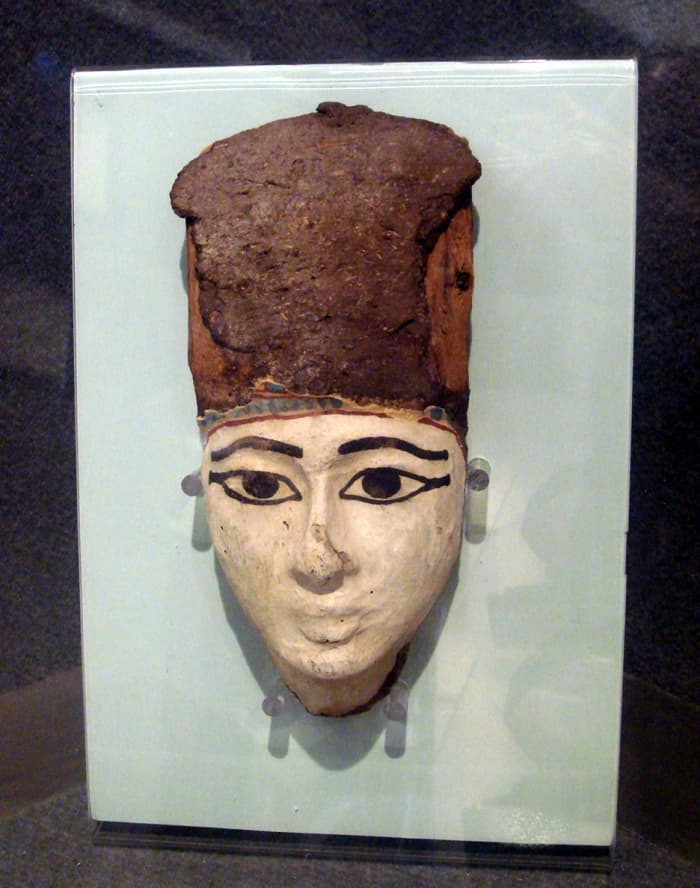
Ancient Egyptian eye make-up was oft very thick and pronounced like on this mask that is displayed at the Egyptian Museum in Milan.
Giovanni Dall'Orto, via Wikimedia Commons
Egyptian Make-upward
In ancient Egypt, both men and women wore brand-up. Near notable was their nighttime, heavy eyeliner that they used forth both the lower and upper eyelids. The eyeliner was usually made upwards of blackness kohl, which is a very common lead ore taken from a mineral chosen galena. They lined their eyelids non just for dazzler, only also because they believed that information technology protected the eyes from dust and dirt.
The Egyptians would employ the aforementioned black kohl to darken eyebrows and eyelashes. Higher up their eyelids, they also used eyeshadow, which was commonly in a shade of blue or green. Both men and women would color their lips and nails with henna dye. They would use this same dye to put color into their hair and to decorate their skin. Although they often painted their hands with henna, only the lower class got tattoos.
The ancient Egyptians too used a cerise pulverisation called crew on their cheeks and lips when they did not use henna. Unfortunately, in that location were a lot of harmful substances used in their make-up that had agin effects, which led to many illnesses, although the Egyptians were unaware of what caused their poor wellness.
Whether they were the poor or the rich, aboriginal Egyptians were very particular virtually how clean they were, and this showed in the clothes, jewelry, and make-up they wore. The cloth used to make their dress, as well as the style of the wearing apparel, was indicative of whether someone was rich or poor. Since status was very important to the ancient Egyptians, article of clothing was a way to signify that divergence.
Citations
- "Egyptian Article of clothing: Pharoahs to Commoners." History. May xi, 2017. Accessed January 27, 2018. http://historyonthenet.com/Egyptians/clothing.htm.
- "Garments." Ancient Egypt: Wearable. Accessed January 27, 2018. http://www.reshafim.org.il/ad/egypt/timelines/topics/wear.htp
Questions & Answers
Question: Did children wear clothing in aboriginal Egypt?
Answer: During the hottest months, children under 6 went around naked. Later on that age, they did wear clothes mainly to protect themselves from the sun. It was not until they hit puberty where they would dress as the adults did.
Question: How was a person's social grade distinguished in ancient Egypt?
Answer: The all-time way to tell the deviation in social classes was by the quality of their clothes. Those of a higher social class would use lighter, more delicate materials such every bit silk, while those in the lower classes would have worn cotton fiber, flax, or linen. Also, those in the higher classes would have more ornaments on their clothing also equally wear more jewelry. The deviation in classes was more pronounced in women than in men.
The 6 social classes in ancient Arab republic of egypt from highest to lowest were:
i. Pharaohs and gods
2. Government officials
3. Scribes and soldiers
4. Craftsman and merchants
5. Peasants
6. Farmers
Question: What did ancient Egyptians wearable most of the time?
Reply: For everyday habiliment, almost Egyptian men in the working course wore a loin cloth or kilt, whereas the woman wore straight dresses. The working class made upwards the large majority of the society since they lived in a very hierarchical society. The lesser beingness the largest group. The further up in the society you were, the more than ornate your everyday habiliment would exist.
Question: Did the kids in aboriginal Egypt wear anything to cover upwards?
Reply: Until they were six years former, many would just run around naked, unless information technology was common cold. When they got older, but before they were part of the different social classes, their clothing varied.
Question: Did aboriginal Egyptian children feel embarrassed that people could run into their body?
Answer: I don't think we could really know, but it was the norm, then I don't believe then. Maybe every bit they got close to being of age, they may have been more self-conscious or even insecure that they were not even so old enough to article of clothing clothes. I don't believe it is possible to truly know the answer. Keep in mind that in different parts of the world, modesty is viewed very differently. Some believe it is of import to cover a woman'south breasts, whereas others it is completely normal for them to get around topless at all times.
Question: Did both men and women clothing jewelry such as necklaces and earrings in aboriginal Arab republic of egypt?
Answer: Aye, they did! Jewelry was a fashion that they were able to get the attention of their gods. Not simply did they article of clothing necklaces and earrings, but some would fifty-fifty wear headdresses. What their jewelry was fabricated of, was dependent on their social continuing.
Question: Why didn't Egyptians dress according to their genders? All of the outfits for men and women look very similar.
Reply: Really, men and women did apparel differently. Their garments were all very similar, because of the ease in which they sewed them, but there were some primal differences. Women tended to article of clothing longer garments. Women also tended to wear a lot more jewelry across the chest. As well, depending on the period, men did habiliment clothes that were more similar to pants. Any similarities in wearable style had more than to do with the era, but they did clothes co-ordinate to their gender.
Question: Did the Egyptians wear makeup to reflect their social status?
Answer: Yes, makeup ofttimes represented a sense of ability. The most meaning difference was the tools they used to apply their makeup. They all had admission to the aforementioned products that they used for makeup, merely more impoverished people relied on clay pots and sticks to help them apply their makeup. In dissimilarity, the more affluent person would use ivory containers, and their tools would be uniquely carved and even bejeweled. Their devices may have afflicted how well they practical their makeup, although that is uncertain. Fifty-fifty their nails frequently reflected their social status. More flush people would take longer darker nails since the working grade would often suspension their nails. The henna that both classes applied to their nails would frequently fade much quicker on those who used their hands to piece of work.
Question: Why did Egyptians wearable clothing that distinguished class and why did they dress co-ordinate to gender?
Answer: The main reason they dressed differently to distinguish grade had more than to do with what kinds of material they could afford. It was not as if they had stated Pharoahs dress similar this and workers apparel like this and so on and so forth. They chose the material based on what was accessible to them.
Equally far every bit why they dressed according to gender, most cultures do have a distinguishing difference co-ordinate to gender and how they dress. More often than not for practical reasons, because our bodies are different. There are different needs in article of clothing per gender.
Question: Did the Egyptians have a pop board game?
Reply: According to ducksters.com, they used to play two board games called Senet and Mehen. Senet is a game that is over 5,000 years old. The game of senet is idea to exist over 5000 years sometime. Senet boards were found buried in pharaoh'south tombs. They believed that what was with you in your tomb would exist present in the afterlife, so they chose to be buried with the senet boards so they would have something to do and then. A mehen lath was circular and had a swirled cavity shaped like a snake coiled upward.
© 2012 Angela Michelle Schultz
jeff on August 03, 2020:
thank you for helping with my projection
Amy-Ann on Apr 28, 2020:
i am still waiting
8 on March 11, 2020:
thank you and so much i learned a lot and it helped me on my project
Mary from Oregon on March 02, 2020:
I really enjoyed reading this information. I know a bit more about ancient Egypt than the average person, only this and 1 of the recommended sites on the status of women, bumped upward my knowledge about ancient Egyptian society quite a bit.
Give thanks you then much for all your research, and for your effort to brand this discipline affair accessible.
hi on January 28, 2020:
I dear aboriginal Egyptian civilization
Charlie Sanders on January 27, 2020:
This is super helpful I learned then much from this :D
annie on October 22, 2019:
this is and then helpful! helped me with my big report on egypt! great task.
Willow on Oct 16, 2019:
Well washed
Twinkle on June 20, 2019:
Practiced
Scarlett True cat on June 04, 2019:
Super Duper Very Good!
louli on June 02, 2019:
tres bien
Zijun on May 12, 2019:
Very good
Suzanne Nott on May 01, 2019:
Helped with my daughter's consignment. Swell info!!!!!!!
Aureate panda on April 16, 2019:
Information technology is so good this is. Helped my homework.got good mark!☺
Lol on April 01, 2019:
This is astonishing!
Annie on March 24, 2019:
God, THIS WAS THE All-time EGYPTIAN SITE EVER! Thank you!
Piper McLean on March 18, 2019:
This site helped me a lot.
Patrica on Feb 28, 2019:
hi its non worth it
lol jk
Amy on February 07, 2019:
Dearest the brand upwards
yeet on January 10, 2019:
i want info on jewelery
Unkown on October 15, 2018:
Thanks!
zara on July 17, 2018:
absurd
Ella on May 11, 2018:
Amazing
kaylah on December 09, 2017:
this is a good website.
Deborah Morrison from Hamilton, Ontario, Canada on Jan 09, 2015:
This hub is fascinating. I liked the pictures and the articulate descriptions. The egyptian clothing styles were unique and beautiful.
Nithya Venkat from Dubai on October 19, 2014:
Corking hub, interesting and informative. Enjoyed reading and voted up.
selena on March xi, 2014:
coooooooooooooool
kay on February 26, 2014:
gggggggrrrrrrrrreeeeeeeeeeaaaaaaaaaaaaattttttttttttttt site about Ancient Egyptians!!!!!!!!!!!!!!!!!!!!!!!!!!!! also great for kids
P.Due south
thanks my teacher would have killed me if I hadn't establish this site..!
Injure on Nov nineteen, 2013:
Information technology helped me soooo much that u and god bless
point2make on October 20, 2013:
I enjoyed your hub and learned some things as well. Thanks and well done!
Tamara on October fifteen, 2013:
I used this data for Egyptian Project.Nifty stuff!
Angela Michelle Schultz (author) from The states on May 25, 2012:
Thank you, I find ancient Egypt and then incredibly fascinating!
maximioum from Spain on May 25, 2012:
so interesting hub. I like your writings. i voted information technology upward and gave interesting.. keep working on
Angela Michelle Schultz (author) from U.s.a. on May 08, 2012:
Thanks for the great compliment.
bmcoll3278 on May 07, 2012:
Bang-up hub. Thank you
hirundine from Nelson, B.C. Canada on May 07, 2012:
angela_michelle,
And then truthful! I see some celebrity chefs calling for cooking lessons for children to assist with the obesity problems. Not a bad thought? I was taught boys activities at school, a million years ago. Cooking and sewing were not in the curriculum. At least for boys.
I went to fine art schoolhouse and was in the cloth program. Which helped. My mother taught me to stitch, darn and knit. Which post-ww2 in great britain was necessary. I still darn holes .... go effigy?
Angela Michelle Schultz (author) from United states of america on May 07, 2012:
Really I accept thought almost that with my daughter attending a public school, she spends all 24-hour interval at schoolhouse and all dark with homework, and she is not learning the simple things in life similar gardening or sewing or crafting. And then she comes domicile with these theories that they have taught my child equally fact, and I have to explain there are a lot of theories out there. It is non fact, it is just one hypothesis of many. I get frustrated. Nosotros don't want to homeschool, but I'one thousand not happy with public school system. A lot of those things are being lost today.
hirundine from Nelson, B.C. Canada on May 07, 2012:
angela_michelle,
Children are treated differently all over the earth, in many ways; y'all and I would likely disagree with? Mostly people accept information technology a bit too seriously? Increases of population bring, different attitudes? Liked this hub on vesture. I've had an interest in cloth making for awhile and can warp a loom. .... depending ;-]
It'south a shame that nosotros, as a society, depend too much on machinery for the turn a profit of a few? Certainly I have an appreciation of arts and crafts. It takes a lot of resource to make just ane linen material. Spare fourth dimension used to be taken up by those activities, not watching sports or movies.
A few beads, some rolls of cloth and hey? Bought yourself a nation .... at present that was an investment that paid off?
That'south how we are more often than not, like magpie's caught by the gleam of tawdry glitter?
Angela Michelle Schultz (writer) from The states on May 07, 2012:
It is amazing the difference in attitude about children in the last hundred years. I do retrieve children are becoming 2 spoiled thinking they have rights they do non have. I am a firm believer children should treat all adults with complete respect. Merely and then a hundred years ago, some people believed children should be seen not heard. There has to be a happy medium.
hirundine from Nelson, B.C. Canada on May 07, 2012:
An informative and well presented hub. Appreciating the research and graphics.
Regarding the children. It may exist that the ancients constitute it easier to to keep them clean, naked; than all the laundry that mothers have today. After all if the climate suits? Why not? As well, only comparatively recently have children gained legal rights and status. So, there may be an element of "waste not, want not" regarding their expense until older? That was much of the thinking through medieval europe? Sounds harsh but that was the reality?
Angela Michelle Schultz (author) from United states on May 06, 2012:
I'm glad to teach you some things. :) Cheers very much!
point2make on May 06, 2012:
Very interesting and informative hub. I appreciate your efforts and institute the facts surprising and fascinating. I know a lot more than most the ancient Egyptians clothing than I did before I read your hub. Thanks. Voted this hub up!
Angela Michelle Schultz (writer) from United States on May 06, 2012:
Completely agreed about the rut. It's really odd to me that the children were more often than not naked.
Dianna Mendez on May 06, 2012:
I found this topic and your writing on the field of study quite interesting. The different classes of social club were marked by their clothing and styles much more than today'southward dress styles. In such heat, cotton fiber and linen would be my option likewise for comfort.
0 Response to "What Did the Ancient Egyptians Wear That Is Common in Todays Fashion Trend"
Post a Comment